Save, spend, and be charitable. Can you do that in the dark?
Three Cups is a simple and sweet picture book that I stumbled across without pictures, because my copy was in braille. Yet even without images the narrative evokes a tangible way for students with low vision or blindness to relate to money and how to manage this resource. One cup for saving, one cup for spending, and one cup for charity.
I look forward to expanding my thoughts on the topic by sharing resources on money management with the angle of accessibility, as in using the Cranmer Abacus, Braille, or other preparation that a TVI would make. TVI stands for Teacher for the Visually Impaired.
Some concepts that need explaining: the Cranmer Abacus is different from the typical abacus, because the beads do not slide up and down according to gravity. Instead, the beads may be adjusted by touch, but, are held in place by a velvety backing similar to the felt top of tables used for playing cards or dice. Braille is a form of writing that usually fits under one finger tip with six dots, or sometimes eight dots, depending on the system or code. Visually Impaired: visual impairment includes but is not limited to being “in the dark,” since vision loss may impact the individual with some change in light perception, glare in the presence of light (think about trying to sail into the sunrise), limited peripheral vision, spotty vision, or other conditions.
So, no need to put on a “bird box” challenge of a handkerchief over your eyes. You might just place some clear contact paper on a pair of safety goggles and try to see through that as well. Now then, set your abacus for $100 divided by 3. Well that doesn’t divide as neatly for a beginner, how about $99 divided by 3, that’s $33, right?
Then, adjust for that “extra” dollar by putting it into saving.
Terrific, you’ve done 1/3 or one-thirds for each cup. Write that in Braille.
While you’re at it, clear your abacus and write 1/3 on your abacus.
Learning a new skill is worth the effort, especially the skill of learning how to manage your resources. Whether your vision is blurry or darkened, your understanding can be clear and tangible! It may just take some practice.
As an aspiring Education Specialist, what would you pack for your special education journey? Time, flexibility, some running shoes, and some therapeutic scents, just for starters. I make these suggestions as my special education journey has taken me on the path onward through a pursuit of a Visual Impairment credential.
If you could pack time in a bottle, then that’s the first item you need to put in your bag for the Special Education journey that specializes in Visual Impairment. My application for California State University Los Angeles began as a non-matriculated student, therefore the funds came out of pocket until I could apply for through FAFSA. To become a matriculated student, forms and applications are due six to four months ahead of the semester. When I started, I only had a few days to enroll for classes, I had to attain the professor’s signature to enroll, and all because I did not enroll ahead of time. I was hired as a Teacher for students with Visual Impairment on the basis of my Education Specialist Preliminary Credential, with a Waiver for Visual Impairment, so I had to hurry and enroll once the job started.
Some forms that you should be familiar with regarding the internship require careful timing, since these forms have specific, ironclad due dates that are set months before the internship begins. What can make this seem difficult at times is that some forms for fieldwork are not intuitively easy to locate. If you use the CSULA software and search engine to locate the survey or the form, then the words must be appropriate and they must be typed at the correct stage in your email or Moodle or GET. Again, the process takes months, for example my application for fall fieldwork started in spring, with follow up in the summer (June 1, 2016). It’s called a “survey” but this form is not about preferences in customer service, it is a vital piece of information that the CCOE or Charter College of Education uses to itemize what they need regarding your TB test, your permission to work as an intern, and other requirements. The Charter College of Education is located at King Hall on California State University on the first floor.
CCOE at CalState LA can help navigate the page to locate the survey which is more than a survey.
My cohorts continued with their fieldwork part two that following spring, but I preferred to enroll for my fieldwork part two for the fall. I had to make it a point to go to the CCOE often in order to receive coaching on where to click or tap to enroll or download the correct form, or the correct survey. As a candidate, you receive an email on Outlook that uses the CalStateLA system, which you are advised to check “daily,” and I checked my email with my MyCalStateLA account every other day. Several steps along the way reminded me of this deadline in this fieldwork process, and I included pictures of the forms and email on this spedjourney.com website so that they may become familiar to others. Do you want to have your VI internship with CSULA? These are what some of the communications look like (Illustrations to follow):
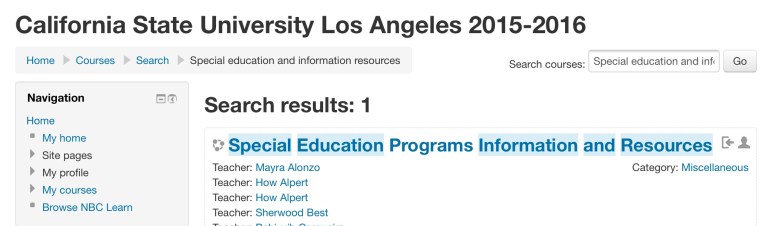
You must specifically type “Special Education Programs Information and Resources” into the search engine before you can access the link for “Online Applications for Fieldwork.” Using “Fieldwork” or “Application for Fieldwork” was not as effective. I’m looking forward to being told that this step has been simplified for other students!
The CCOE will take the time to email you the link you need in order to meet the deadline, but it’s vital that you check email daily.
This is a screenshot of the results from a search using the keywords “Special Education Programs Information and Resources.” To reach the links you must use the university website.
The site administrator must give you permission for you to work with student(s) as an intern.
Pack a calendar or a great organizer and planner notebook, since time doesn’t come in a bottle.
If you could pack flexibility, then that’s the next item you need to put in your bag for Visual Impairment. There are bumps in the road, and that’s acceptable if you can bounce back. Personally, I had different a script for this journey through special education. My script originally was as follows: once I finished my Education Specialist Preliminary with National University, I planned to work for a few years in RSP, helping students with Mild to Moderate learning disabilities. During that time I would post insights on National University on my website. Eventually, maybe after two years, I would go back to school to begin my Visual Impairment credential. That would have given me time to look into options and compare. For example, as a candidate for Visual Impairment in California I would have compared California State University Los Angeles and its VI program with the VI program at San Francisco State University. I might have had a better time becoming a matriculated student. I certainly had some difficult evenings, rushing to the campus after a late IEP at work, just to try and pay for my course enrollment before the payment office closed at 6 p.m. Even though I was in a rush, I still needed two minutes to change out of my formal shoes and put on running shoes. The campus for CalState LA spans several staircases over some hilly terrain. It was considerably a squeeze since I had to pay out of pocket as a non-matriculated student. Although you can pay online, I was not taking any chances and had a cashier’s check issued those first three quarters, to ensure that the payment would clear. After signing my contract, I only had a matter of days to act upon the payment and other requirements. I chose California State University Los Angeles out of necessity, since it was driving distance from my school district, and at that time I was not aware of the VI program in San Francisco.
So, add a note to pack really big rubber bands to help bounce back from suddenly changing plans, a pair of running shoes to wear on those days you must quickly get around campus, and a pleasant fragrance that will encourage you to breathe deep and keep going.
There are more items to pack as you consider your journey, so consider this an introduction as I describe the journey. I welcome your comments on what you would pack as well!



 spedjourney.com